
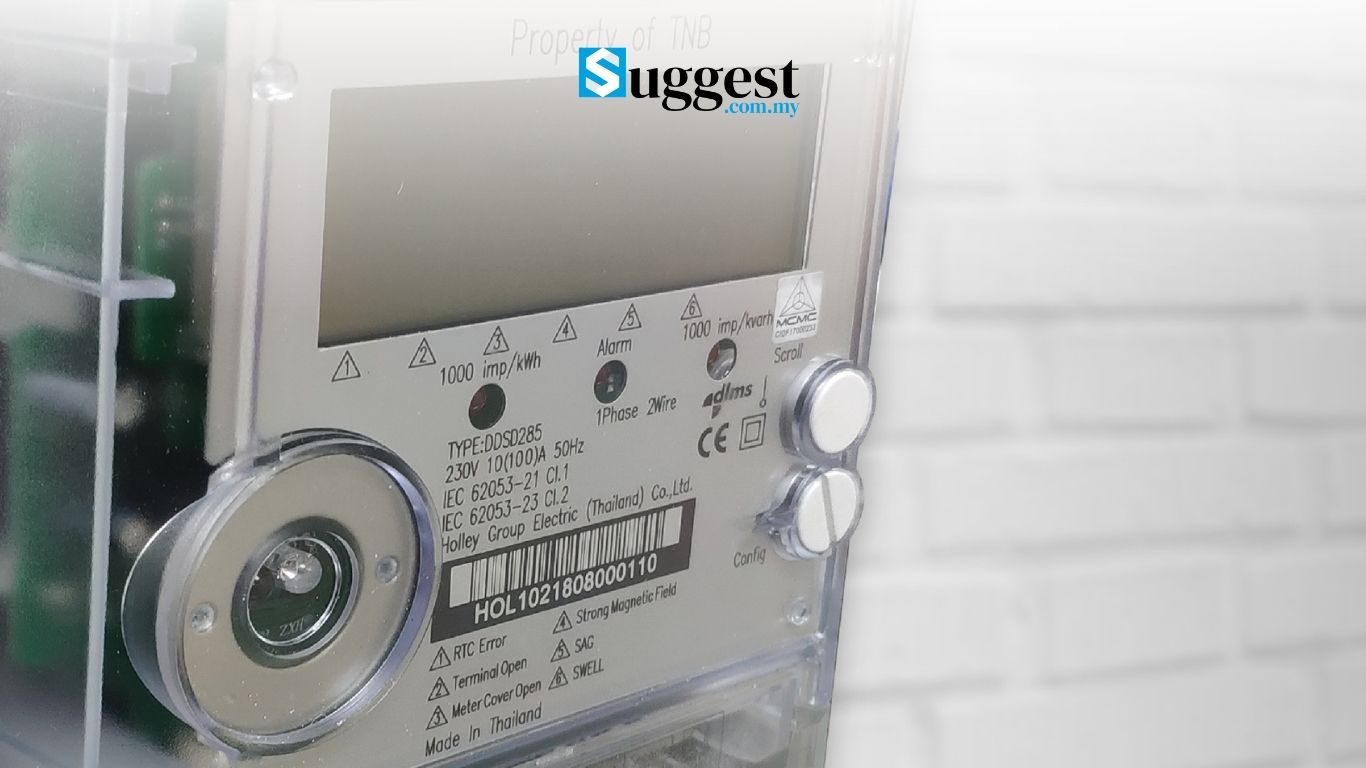
The Highlights
- The government has temporarily raised the electricity bill protection threshold for eligible TNB domestic customers from 600 kWh to 800 kWh per month for electricity consumption from September through 31 December 2026.
- Customers using 800 kWh or less are protected from the Automatic Fuel Adjustment (AFA), retail charge and applicable service tax under the temporary measure.
- Over a 30-day period, 800 kWh works out to about 26.7 kWh per day, though actual billing cycles may vary.
- The biggest savings usually come from managing high-consumption appliances such as air-conditioners, water heaters and dryers rather than focusing on very small loads.
- Electricity savings should remain practical: during very hot weather, comfort and health may be more important than reducing a few extra kWh.
There is a little more reason than usual for households to keep an eye on electricity consumption before the end of the year. On 17 September 2026, Prime Minister Datuk Seri Anwar Ibrahim announced that the electricity bill protection threshold for domestic users would temporarily increase from 600 kWh to 800 kWh per month, covering electricity consumption from 1 September until 31 December 2026.
For practical purposes, the measure relates to TNB domestic customers in Peninsular Malaysia, where the relevant electricity tariff and Automatic Fuel Adjustment framework applies. Eligible customers consuming 800 kWh or below per month are exempt from the Automatic Fuel Adjustment (AFA), retail charge and applicable service tax during the temporary period.
TNB said the expanded protection is expected to benefit more than eight million domestic users, or up to 90% of its domestic customer base. However, the lower your actual electricity use, the less electricity you are paying for in the first place, so 800 kWh is better treated as a ceiling rather than a target.
Read More: Fuel Price Uncertainty: Are Malaysians Doomed?
What Exactly Is the Electricity Bill Relief Until 31 December?
Before the September announcement, the protection threshold stood at 600 kWh per month. The temporary measure increases that threshold by another 200 kWh, giving more domestic customers room to remain within the protected level through the end of 2026.
Item | Temporary Arrangement |
Previous Protection Threshold | Up to 600 kWh per month |
New Protection Threshold | Up to 800 kWh per month |
Effective Period | 1 September to 31 December 2026 |
Automatic Fuel Adjustment | Exempt for qualifying usage |
Retail Charge | Exempt for qualifying usage |
Service Tax | Exempt for qualifying usage |
Relevant Customers | Eligible TNB domestic customers |
The measure does not mean electricity is free below 800 kWh. Customers still pay for the electricity they use, but qualifying households are protected from the specified additional bill components. TNB also said relief relating to September consumption would be reflected through October electricity bills.
How Can You Stay Below 800 kWh a Month?
Eight hundred kilowatt-hours can feel abstract until you break it down. Over 30 days, 800 kWh works out to about 26.7 kWh per day.
Households that want some breathing room could instead aim for roughly 23 to 25 kWh per day, although this is only a planning guide.
Monthly Target | Approximate Daily Average |
600 kWh | 20 kWh |
700 kWh | 23.3 kWh |
750 kWh | 25 kWh |
800 kWh | 26.7 kWh |
Actual electricity bills follow billing cycles, which may not match a neat 30-day calendar month, so check the consumption shown on your account or bill rather than relying only on daily averages.
The easiest way to cut usage is to focus on appliances that either draw a lot of power or run for many hours. That usually matters much more than worrying about small amounts of standby electricity.
Start With Air-Conditioning
For many Malaysian households, air-conditioning is one of the most obvious places to look for savings. The Energy Commission recommends an air-conditioner setting of around 24°C to 26°C for efficient household use.
If you normally use very cold settings such as 18°C or 20°C, trying 24°C or 25°C may reduce consumption while still keeping the room comfortable. Timers or sleep mode can also help if the aircon does not need to run until morning, while keeping doors and windows closed prevents warm outside air from constantly entering the cooled room.
Regular maintenance matters too. Dusty filters can restrict airflow, while cooling empty rooms is simply unnecessary. A fan may also help circulate cool air and make a moderate thermostat setting feel more comfortable.
There is, however, a sensible limit to electricity saving. During very hot weather, or for people particularly vulnerable to heat, using a fan or air-conditioning may be necessary for comfort and health. A small saving is not worth creating an unsafe or intolerably hot indoor environment.
Which Appliances Deserve the Most Attention?
You do not need to micromanage every socket in the house. Focus on bigger loads and repeated use.
Water heaters: Instant electric water heaters draw relatively high power while operating, so reducing unnecessary shower time can help.
Refrigerators: Do not switch your fridge off every night. Instead, keep the door closed as much as practical, check that seals work properly and avoid unnecessarily cold settings.
Clothes dryers: Natural drying can eliminate an entire dryer cycle when the weather and living situation allow it. Of course, dryers remain useful during rainy weather or when clothes are needed quickly.
Washing machines: Wait for reasonably full loads where practical, and use eco modes if your machine offers them.
Cooking appliances: Electric ovens, air fryers and induction cookers can draw relatively high power, although usually for shorter periods. Batching cooking or reheating can sometimes be more efficient than repeatedly warming the same appliance.
How Can You Estimate Appliance Electricity Use?
A simple calculation is:
Power in watts ÷ 1,000 × hours used = kWh
For example, an appliance drawing 1,000 watts continuously for eight hours would theoretically use 8 kWh.
Real-world consumption can vary. Air-conditioner compressors cycle, inverter units adjust their output and refrigerators switch cooling systems on and off throughout the day, so use this formula as an estimate rather than an exact bill prediction.
Its main value is helping you identify which appliances are likely to matter most.
Should You Move Electricity Use to Off-Peak Hours?
Only if your tariff makes it worthwhile.
For customers on a normal domestic tariff, simply moving the washing machine from 7pm to midnight does not automatically make each kWh cheaper. However, eligible customers enrolled in TNB’s Time-of-Use (ToU) scheme can pay different rates depending on when electricity is used.
Period | Time |
Off-Peak, Monday to Friday | 10pm to 2pm |
Peak, Monday to Friday | 2pm to 10pm |
Saturday and Sunday | Off-peak throughout the day |
For ToU customers, flexible activities such as laundry or EV charging may be worth shifting into off-peak periods. TNB also advises customers to consider their normal electricity-use patterns before choosing the scheme.
Timing alone, however, does not reduce total consumption. If the main goal is to remain below 800 kWh, reducing unnecessary overall usage remains important.
Read More: POCO F9 Pro vs Samsung Galaxy S26 FE: Which Is Better?
Track Your Usage Before the Bill Arrives
Waiting until the bill arrives before discovering that your household used 860 kWh is not particularly useful. Check your consumption during the billing cycle instead.
If you are aiming for around 750 kWh over roughly 30 days, a simple guide would be about 250 kWh by Day 10 and 500 kWh by Day 20. Check again around Day 25 so there is still time to reduce discretionary heavy-appliance use if consumption is running high.
The numbers will not rise evenly every day because hot weather, guests, school holidays and extra laundry can all affect usage. The point is simply to spot the trend before the billing cycle ends.
The Easiest Electricity Savings to Make This Week
There is no need to renovate your house or replace every appliance before December. Start with simple changes: use sensible aircon temperatures, reduce unnecessary cooling hours, clean filters, switch off unused lights and appliances, wash fuller loads, dry clothes naturally where practical and cut unnecessary hot-water use.
Most importantly, prioritise larger loads. A few hours of unnecessary air-conditioning will usually matter more than obsessing over a phone charger left plugged in.
The key word is unnecessary. If an appliance genuinely improves comfort, health or everyday life, there is no need to stop using it simply to hit a target.
Is It Worth Buying a More Energy-Efficient Appliance?
Possibly, but usually only when an appliance already needs replacing.
Malaysia uses energy-efficiency labels to help consumers compare regulated products such as refrigerators, air-conditioners, fans, televisions, lamps and washing machines. When comparing products, look at stated electricity consumption, efficiency rating, appropriate size and how often the appliance will be used.
There is also an important 2026 change for air-conditioners. The Energy Commission introduced a new star-rating schedule covering 1 January 2026 to 31 December 2029, applying to products whose Certificate of Energy Efficiency applications are submitted from 1 January 2026 onwards.
Units certified earlier may continue using previous labels until those certificates expire, so consumers may temporarily see products rated under different schedules. When comparing air-conditioners, check the year and stated energy consumption instead of relying only on the number of stars.
What If Your Household Already Uses More Than 800 kWh?
Start by looking at your previous three to six bills and identifying months with unusually high consumption. Then consider what changed: hotter weather, more people at home, longer aircon use, additional dryer cycles or EV charging.
If your household regularly uses 900 to 1,000 kWh, meaningful savings are more likely to come from larger loads than tiny devices. Reducing unnecessary aircon hours, using moderate temperatures, cutting excessive dryer use or reviewing water-heater habits is likely to matter more than switching off a Wi-Fi router overnight.
Even if you cannot get below 800 kWh, reducing consumption still helps. Using 900 kWh instead of 1,000 kWh means you are buying less electricity, so the threshold should not become an all-or-nothing target.
How Can You Save Without Making Life Miserable?
The objective is not to spend the rest of 2026 sitting in a hot living room watching the electricity meter.
Use electricity where it genuinely improves your comfort and daily life, while cutting obvious waste. That could mean running an aircon at 25°C instead of 19°C, washing fuller loads, drying clothes naturally when convenient and checking electricity consumption regularly.
Every household is different. Someone working from home needs a computer running for much of the day, families with children naturally do more laundry, and older people, babies or anyone sensitive to heat may need more cooling. In those situations, comfort, health and practicality can outweigh a marginal electricity saving.
Efficiency should make your household cheaper to run, not harder to live in.
Save, But Within Reason
The temporary electricity bill protection gives eligible TNB domestic customers in Peninsular Malaysia a larger cushion through 31 December 2026, with the protected consumption threshold rising from 600 kWh to 800 kWh a month.
The most sensible approach is still to keep electricity use as low as reasonably practical. Monitor your kWh, pay attention to air-conditioning and other high-consumption appliances, use efficient settings and treat 800 kWh as a ceiling rather than a target.
At the same time, do not sacrifice reasonable comfort or health simply to reduce a few extra kilowatt-hours. The best strategy is straightforward: cut electricity you do not need, and use the electricity you do need as efficiently as possible.
For more timely updates on policies affecting Malaysian households and businesses, readers can follow Suggest MY for the latest business and economy news.
Frequently Asked Questions About Electric Bill Savings During the Relief Period
What Is the 800 kWh Electricity Bill Relief?
The government temporarily increased the protection threshold for eligible TNB domestic customers from 600 kWh to 800 kWh per month. The measure applies to electricity consumption from 1 September to 31 December 2026.
What Happens If I Use 800 kWh or Less?
Qualifying customers within the threshold are protected from the Automatic Fuel Adjustment (AFA), retail charge and applicable service tax during the temporary period. Electricity itself is not free, so using less can still reduce your bill.
How Much Is 800 kWh Per Day?
Across a 30-day period, 800 kWh works out to approximately 26.7 kWh per day. This is only a planning guide because actual billing periods can vary.
What Aircon Temperature Is Recommended for Saving Electricity?
The Energy Commission recommends around 24°C to 26°C for efficient household air-conditioning. However, comfort and health should take priority during extremely hot conditions.
Is Electricity Cheaper at Night?
Not for everyone. Lower off-peak pricing applies to eligible customers on TNB’s Time-of-Use (ToU) scheme. For other customers, reducing total electricity consumption is generally more important than simply changing when appliances are used.
What Happens After 31 December 2026?
The expanded 800 kWh protection is scheduled to apply through 31 December 2026. Consumers should check later TNB, Energy Commission or government announcements for arrangements from January 2027 onward.